8 min read1,424 words
Muji kept 1.09 million card numbers it no longer needed
Muji's breach exposed up to 27.26 million customer records and the full card numbers of 1.09 million MUJI Card holders, stored without masking or encryption five years after Muji stopped needing them. Its online store stayed open for days after the second intrusion was found.
Ryohin Keikaku, the company that runs Muji, has disclosed a breach that may have exposed up to 27.26 million customer records, including those of people who had closed their accounts, and the full card numbers of about 1.09 million MUJI Card holders.[1][2] The card numbers had been stored with no masking or encryption, five years after Muji stopped needing them.[3] With Nitori's, it is one of the two largest breaches in Japan this year; Why Japan is bad at software and cybersecurity covers the rest.
What happened, day by day#
| Date | What happened |
|---|---|
| October 23 | Muji's sale, 無印良品週間, begins: 10% off, in stores until November 3 and online until 10:00 on November 4[4] |
| October 29 | Unauthorized access to the systems behind the MUJI app is detected[1] |
| October 30 | Muji announces that up to 27.26 million records may have leaked: email addresses, dates of birth and gender, including those of people who had closed their accounts[1] |
| November 1 | A second unauthorized access, to the online store, is detected. It is cut off sometime before November 4[1] |
| November 4 | Muji announces that about 520,000 records also include names, addresses and phone numbers, and that the full card numbers of about 1.09 million MUJI Card holders may have been accessed. The app and the online store are still open[2][5] |
| November 6 | The online store and part of the app are suspended[6] |
| November 9 | Muji announces that about 270,000 online-store accounts were entered with passwords stolen from other services, and that names and postcodes of about 440,000 cash-on-delivery recipients were also exposed[6] |
| November 12 | President Satoshi Shimizu apologises at a press conference. The online store has no date to reopen[7] |
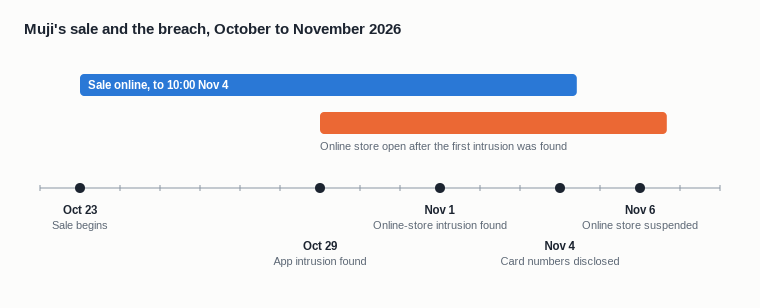
Both intrusions were found during the sale. Muji found the first on October 29, the seventh day of the sale, and knew that up to 27 million records may have leaked. It found the second, into the online store, on November 1, with three days of the online sale left. The online store stayed open through the end of the sale, and for two more days after it, until November 6. Asked at the press conference why it kept selling, President Satoshi Shimizu said Muji had assumed it was dealing with a single attack, and judged that once it stopped that attack it could keep trading. Looking back, he said, it should have acted sooner.[8]
What leaked#
| Group | Records | Data |
|---|---|---|
| MUJI app and online-store members, including former members | Up to 27.26 million | Email address, date of birth, gender, member ID[2] |
| Part of the above | About 750,000 | Name, address, phone number[6] |
| MUJI Card holders who joined between October 2000 and July 2021 | About 1.09 million, about 345,000 of them still valid | Full card number, MUJI Card ID, date of birth. No cardholder name, expiry date or security code[9] |
| Part of the still-valid cards | About 168,000 | The card number together with email address, date of birth, gender and member ID; for about 25,000 of them, also name, address and phone number[10] |
| Cards saved in the app or online store | About 120 | First 6 and last 2 digits of the card number, and the cardholder name[2] |
| Online-store accounts entered with stolen passwords | About 270,000 | Purchase history and points[6] |
| Cash-on-delivery recipients, January 2020 to February 2025 | About 440,000 | Name and postcode[6] |
All figures are what Muji says may have been accessed. Credit Saison, which issues the MUJI Card, says it has seen no increase in fraudulent use and is reissuing cards on request, and Muji says it will pay the full reissue fee.[8][9]
Why the card numbers were there#
From October 2000 to July 2021, Credit Saison passed MUJI Card numbers to Muji so that Muji could give cardholders points.[11] Muji says it used the card numbers to identify customers until July 2021, when it changed the system and ended the link.[3] The numbers it had already collected should then have been deleted. They were not, and they had been stored without masking or encryption.[3] Muji says it did not keep them on purpose and blames failures in how it managed the data; it does not yet know whether a person or the system was at fault.[3]
Most of the 1.09 million belong to cards that had already been cancelled or had expired.[9] Muji had no reason to still hold them. How the attackers got in has not been disclosed.
Muji says it used card numbers to identify customers.[3] Whether the number was the customer table's main key or a field linking Muji's records to Credit Saison's, a full card number was serving as an identifier, and it sat with no masking or encryption.
Who builds Muji's systems#
In 2016, Muji's member app was built by an outside app vendor.[12] In August 2021, the month after Muji stopped identifying customers by card number, Nikkei reported that it had only a handful of engineers of its own and planned to hire about 100 for a new EC and digital services department.[13] The card-number design, and the clean-up that never happened, both date from when Muji had almost no engineers of its own. In Japan that is common: 73.6% of IT workers work for contractors that build systems for other companies, as part 2 of the GMO series shows.
One of many basic failures#
Muji's breach is the same kind as most of this year's breaches whose cause has been disclosed. KDDI stored passwords without protection. Kyushu Electric kept an unencrypted drive in an unlocked cabinet. At JAL, one contractor employee could delete data and rewrite the logs that recorded it. Aflac had nothing to stop someone pulling large amounts of data in a short time. GMO did not notice attackers on its management server for 64 days. The full table has the details.
How this is normally done#
No company I have ever worked for stored credit card numbers. The best security is not to store that data at all. Card payments go through a provider such as Stripe, which keeps the card details and gives the company only a reference to them. If I had suggested storing card numbers at any of those companies, it would have been caught in code review, by database monitoring or by network monitoring, and I would probably have had a call from a security engineer within the hour.
What the law does and does not do#
Since 2018, Japan's Installment Sales Act has required merchants either not to hold card data or to protect it to the PCI DSS standard. Muji says it is checking whether it broke the law.[3] The privacy regulator cannot fine it: Japan's new surcharge does not cover breaches caused by poor security, and it takes effect by July 2028 at the latest, as part 4 of the GMO series explains.
What happens next#
It will look like what happened after GMO's breach a few weeks ago. The media will tell consumers to be careful with their passwords, though there was nothing they could have done about the card numbers Muji kept. There will be talk about AI agents enabling attacks like this, and someone will ask whether it was North Korea.
None of that addresses the cause. Japan needs its own version of the GDPR. Companies that ask for or keep personal information they don't need should bear the cost when it leaks.
References#
- ITmedia ビジネスオンライン, 【なぜ防げなかった?】無印良品、不正アクセス巡る12日間 「クレカ全桁」「会員情報2726万件」漏えいの背景は, November 12, 2026.
- ITmedia NEWS, 無印良品、クレカ「MUJI Card」カード番号全ケタ、約109万件漏えいか 不正アクセスで続報, November 4, 2026.
- ITmedia NEWS, 無印良品「21年までクレカ番号で顧客を識別していた」 “全ケタ保有&漏えい“巡り謝罪 削除漏れなぜ発生, November 12, 2026.
- Travel Watch, 全品10%オフ「無印良品週間」2026秋の開催決定! スタッフが買ってよかった商品リスト公開, October 2026.
- @IT, 無印良品の情報流出拡大、「ネットストア」やクレカ情報にも不正アクセスか, November 7, 2026.
- Innovatopia, 無印良品ネットストア、リスト型攻撃で再開延期 不正ログインの可能性は約27万件, November 2026.
- 日経クロステック, 良品計画が不正アクセス巡り会見、破棄すべき情報の流出可能性などを謝罪, November 12, 2026.
- FNNプライムオンライン via dメニューニュース, 「早く対応していれば」無印良品が謝罪 不正アクセス受けクレカ番号16桁流出 “マスクなし”情報「5年前に削除すべきだった」, November 12, 2026.
- クレディセゾン, MUJI Card 会員情報の流出の可能性に関するお知らせとお詫び, November 4, 2026.
- FASHIONSNAP, 無印良品の不正アクセス、カード番号109万件も全桁閲覧された可能性 氏名や住所も対象, November 4, 2026, updated November 5.
- INTERNET Watch, 無印良品、「MUJI Card」のカード番号約109万件の流出可能性も判明、過去にポイント付与のためデータ保持, November 6, 2026.
- @IT, 良品計画に見る、ビジネス部門主導のAPIベース開発がもたらした効果と教訓, April 21, 2016.
- 日経クロステック, 良品計画やセブン&アイも本腰、小売業でシステム開発の「内製」が活発化する訳, August 17, 2021.