11 min read2,351 words
I moved back to Japan after 12 years, and Japan changed my name without my consent
While I lived in Australia, the Japanese government changed my name on record from Kai to Gai without asking me. Fixing it took 2 trips to Shinjuku City Office and more than 5 hours.
In October 2026 I moved back to Japan after 12 years in the United States and Australia. At the end of the month I went to Shinjuku City Office, the office of one of Tokyo's 23 wards, to sign up for health insurance. While I was filling in the form, the staff told me my name was not what I thought it was. My name is Kai. Their record said Gai.
Changing it back took 2 visits: 4 hours the first time and 75 minutes the second. At the second visit I explained my case 3 times and wrote the same details on 3 forms. By my estimate, handwritten forms cost Shinjuku's 10 branch offices about 37,000 staff hours a year.
The staff said my name had already been changed to Gai#
The form asked for my name in kanji and for its reading. I wrote Kai (カイ). The staff said my name was Gai (ガイ). I was shocked and speechless. The kanji in my name can be read either way, but my name is Kai.
Then I said, "No, that's not true. My name is Kai, and my passport says KAI." They said, "Well, your name has already been changed to Gai."
That made no sense. My name is Kai, last time I checked, and every time I've checked.
Their explanation was that until last year the national record held only the kanji. Readings were kept only by each prefecture, city or ward, and last year the government decided to bring them together. They said they had not known how to read my name, so they had mailed me a letter asking me to confirm it. I did not reply, so my name was changed to Gai.
The law behind this took effect on May 26, 2025. Since then the family register (戸籍) has recorded the reading of each name.[1] Until then, a municipality held only the reading written on a birth notification or a similar filing, and kept it for its own office work.[2] The law makes no exception for people abroad.[3]
Kai is an ordinary Japanese name, and Gai is not a Japanese name at all.
The letter went to my address from 12 years ago#
The letter went to the address they had on record from 12 years ago, in Japan. Before I left, I filed a notice of moving abroad (海外転出届), and I had given the government my Australian address. I never saw the letter.
The Ministry of Justice's page says these letters could not be sent to people who had moved abroad.[4] By law, once that notice is filed, the address record kept with a person's family register (戸籍の附票) shows only that they have moved abroad.[5] Mine was sent anyway.
The government already knew my name was Kai and where I lived#
The passport that says KAI was issued by the Japanese government. The Ministry of Justice's guidance names a passport as a document that shows how a name is read in practice.[4] It also tells people to check the reading on their passport before filing: if the family register ends up with a different one, they may have to change their other records.[2]
I had reported my move to Australia to the Ministry of Foreign Affairs (外務省), so it had my Australian address and my email address. So did its consulate in Sydney, which I visited often. The Ministry of Justice's page says people abroad should file their reading at a consulate.[4] The consulate emailed me constantly about things I did not care about, and never about the registration.
The ward office does not know my email address. It has never asked for it: its forms ask for a postal address and a phone number. So I knew I would get no email notification and no email confirmation from them.
First visit: 4 hours and no receipt#
At first the staff told me I would have to go to Shibuya to get the reading changed. I argued. I had not made this change or agreed to it, so I did not see why I should spend my own time undoing it. They then agreed to handle it at Shinjuku. The Family Register Act lets you file in the municipality where you are,[3] and Shinjuku's website says a reading can be filed at the desk of the municipality where you live.[6]
When I handed in the form to change my name back, I asked whether I could take a photo of it as confirmation, because I did not want to go through this again. They said no. I walked out with a verbal promise and no proof that I had filed anything. I found out later that the person who files has a legal right to a certificate saying the filing was accepted,[3] and that Shinjuku issues it for 350 yen.[7]
A reading that the mayor recorded because nobody filed one can be changed once with a form. Any change after that, including any change after my correction, needs the permission of a family court.[4]
Before I left, the staff told me the change would take a week or more to show up in all of the systems, and that until then I should avoid using my ID or going to the doctor.
For 3 to 4 weeks my ID still said Gai#
My ID is a My Number Card, which is also my health insurance card, and it still said Gai. For the next 3 to 4 weeks it caused confusion every time I used it. At the doctor's, the staff would see Gai, and each time I had to say, "No, it's not correct. They changed my name by accident, and my name is Kai." I got tired of it. I also had no way to check whether the change had been processed, because I had nothing in writing.
Second visit: 75 minutes and the same details on 3 forms#
On November 25 I went back to Shinjuku City Office to get the card itself changed. By law, when something recorded on a My Number Card changes, the holder has to report it to their municipality within 14 days and hand in the card.[8] Nobody at the first visit told me I would need to come back.
Staff in orange vests stand near the entrance and ask visitors what they have come for. I started explaining to one of them. She interrupted me before I finished, went to talk to a second member of staff, and handed me over to her. I explained everything again. The second woman walked me to a ticket machine. It was the one for the desk where I had filed the change at the first visit. The first woman had not listened to the end, so I had been sent to the wrong desk. I told the second woman I had already filed the change and only needed the card updated, and she took me to a different desk nearby.
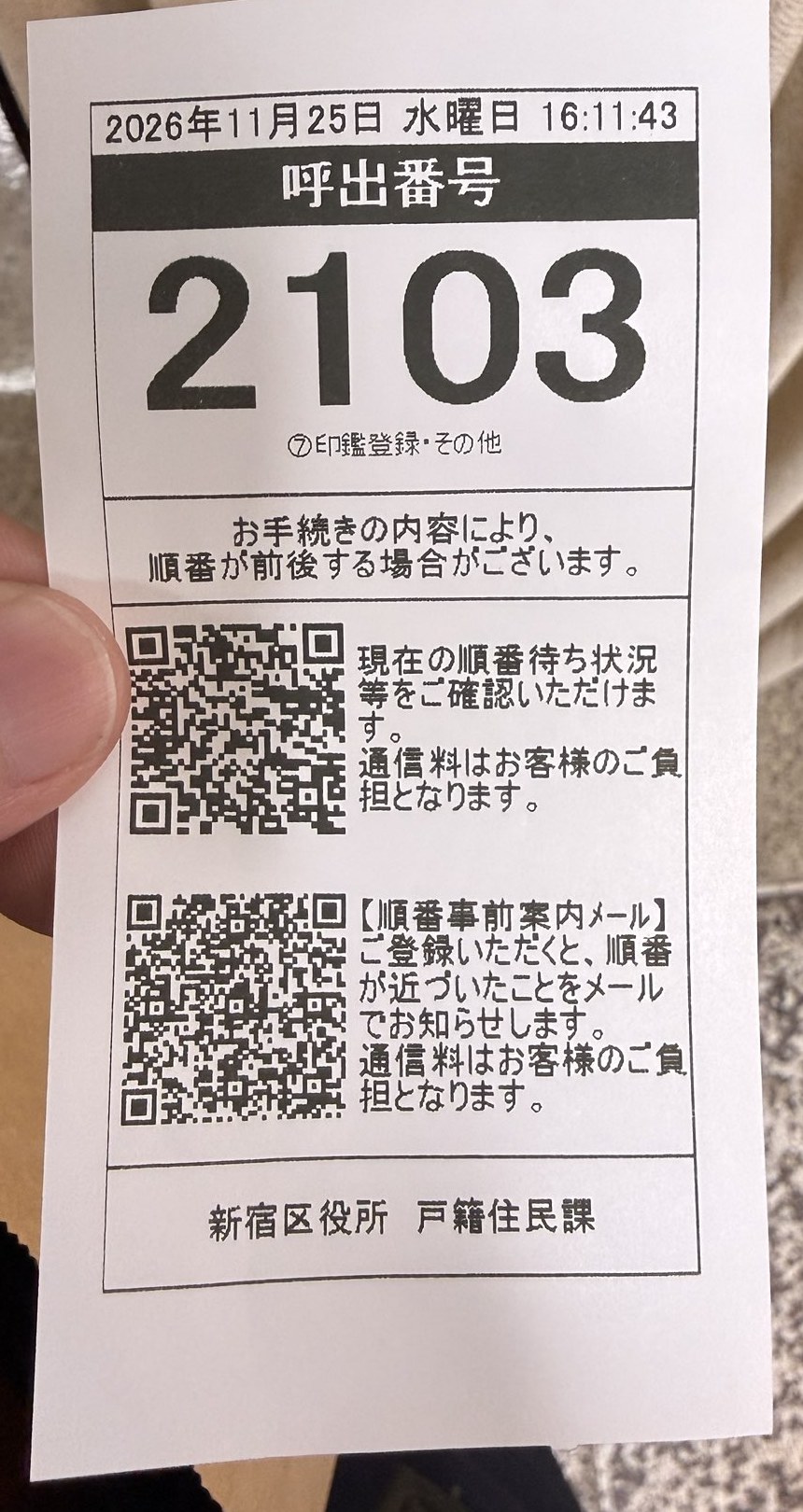
My ticket, printed at 16:11:43 on November 25: a number, a desk category, and two QR codes, one for checking the queue and one for an email when my turn is near.
I waited 15 to 20 minutes. When my number was called, I explained the situation for the third time. The woman at the desk gave me a form to fill in: my name in kanji, its reading, my address, phone number, "My Number" and date of birth. Then she sent me back to the waiting area. About 20 minutes later she called me over and gave me a second form, and I wrote the same details again. After another 15 to 20 minutes I was called to a different desk, where I wrote them a third time.
The staff had my My Number Card in front of them, and almost everything the forms asked for is printed on it.
While the woman at the first desk was looking at my card, she said, "Wow, this Gai is written so small! I wonder who wrote it, they are very skilled." I had not known until then that the reading on the card is written by hand. The new one was written by hand too.
After 75 minutes my card said Kai.
The second visit, from my account. Times are approximate. Of the 75 minutes, 50 to 60 were waiting.
For me, the cost was 5 hours and 15 minutes at the office and 3 to 4 weeks of explaining my name at the doctor's. At the second visit alone, at least 4 members of staff dealt with me.
The office runs on paper, and every form asks for the same details#
I was shocked by how much of the work was done with pen and paper. Behind the desks there were binders, cabinets and stacks of paper everywhere. The sample forms at the writing desks ask for the same details at the top of each one: address, name, reading, date of birth, phone number.
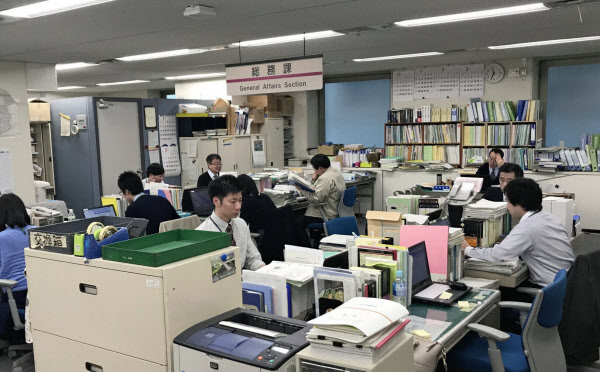
Behind the desks at a Japanese local government office. Photo: Nikkei.
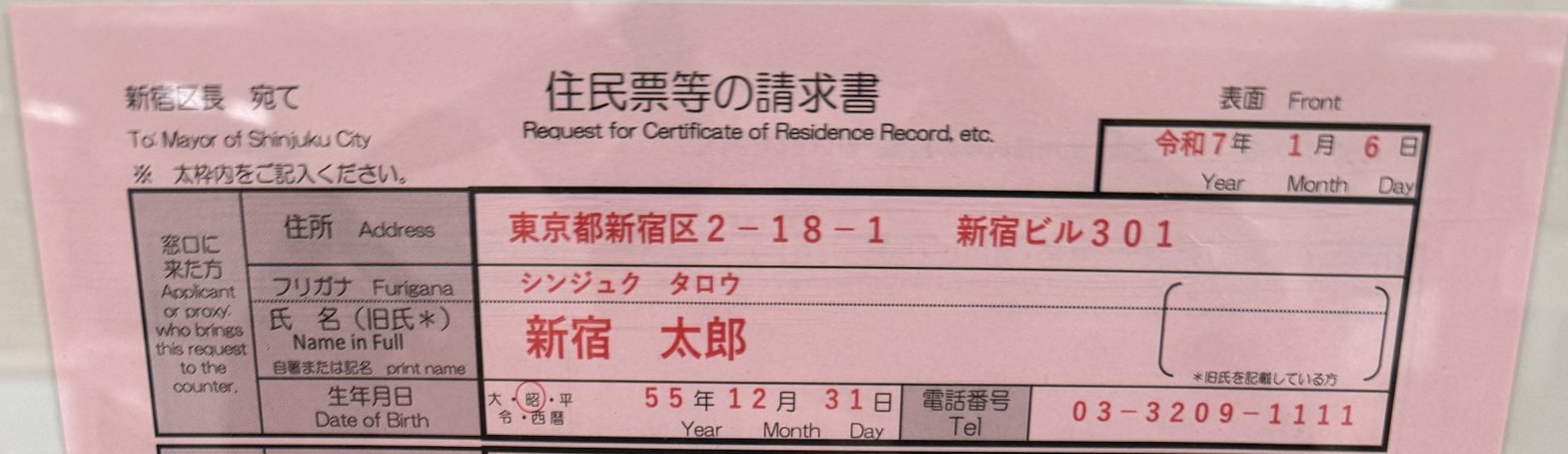
The sample residence record request at the writing desks. The requests for the family register's address record and for family register certificates start with the same block.
As of February 2023, 304 municipalities (17.5%) had what the government calls a no-writing desk (書かない窓口), where the resident does not write out the forms by hand.[9] I found no such desk on Shinjuku's website.
The ticket says which desk, not why I came#
Every 2 to 3 seconds a machine read out a 4-digit number and the desk its holder should go to. Several machines did this at once, and the numbers were also shown on monitors. There were 4 or 5 staff in orange vests, and when they were not answering questions they repeated each number after the machine.
Each department runs its own queue: Shinjuku's website lists a separate waiting status for the family register and resident section, for health insurance and pensions, for tax, and for the branch offices.[10]
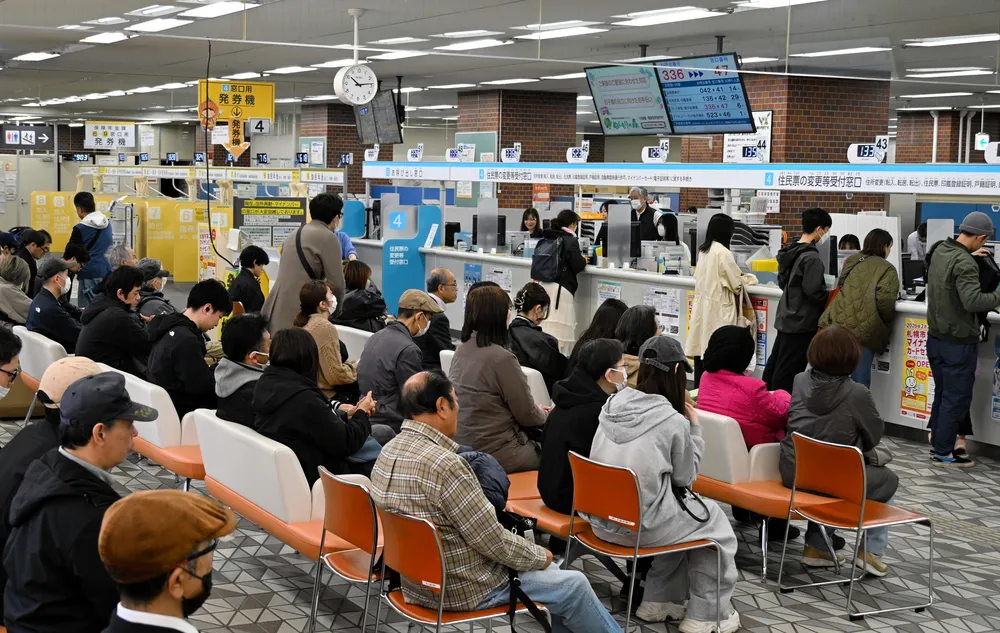
The waiting area at a ward office in Sapporo. Photo: Hokkaido Shimbun.
As far as I could see, the ticket carried a number and a desk category, and nothing else about why I was there. At each desk, the staff did not know what I had come for until I told them or a colleague told them in person. I had to explain my situation, what happened at my last visit, and why I came back, 3 times.
The office does not know how many visitors came, how many of them left with their issues or requests resolved, and how many had to come back another day to finish the process.
Handwritten forms cost Shinjuku ¥144 million a year#
Shinjuku ward office publishes how many requests it handles each year, by type of request.[11] In fiscal 2024 (April 2024 to March 2025), it handled 491,463 requests:
| Category | Requests |
|---|---|
| Certificates (residence records, family register, registered seal, tax and others) | 209,169 |
| Changes to the resident register, such as moves | 73,946 |
| My Number and My Number Card procedures | 57,283 |
| Electronic certificates on the My Number Card | 55,395 |
| National health insurance | 30,973 |
| Medical insurance for people aged 75 and over | 6,167 |
| National pension | 3,515 |
| Family register filings | 3,324 |
| Long-term care insurance | 636 |
| Other (notices, dog registration, child allowance and others) | 51,055 |
| Total | 491,463 |
Two cities that stopped making residents write forms by hand measured the difference. In Kumamoto, each filing took staff 7 minutes less and the resident 4 minutes 30 seconds less. In Kizugawa, a certificate went from 8 minutes to 5, and a move from 16 minutes to 7.[12]
To apply those figures to Shinjuku's branch offices, I used these inputs:
| Staff hours today | Staff hours wasted | Salary wasted | |
|---|---|---|---|
| Certificates | 27,890 | 10,460 | ¥40 million |
| Filings | 61,660 | 26,980 | ¥104 million |
| Total | 89,550 | 37,440 | ¥144 million |
Today these requests take the branch offices about 90,000 staff hours a year, or ¥344 million in salaries. Without handwritten forms, they would save about 37,000 staff hours a year, or ¥144 million. Residents would save about 28,000 hours, worth about ¥48 million.
Tokyo's 23 wards had 9,730,552 residents on January 1, 2025, 27.6 times Shinjuku's 352,717.[15] If the other wards handle as many requests per resident and have not yet changed their desks, the 23 wards together would save about 1.03 million staff hours a year, worth about ¥4.0 billion. Their residents would save about 770,000 hours.
In part 2, I model the office as microservices.
References#
- 法務省, 戸籍にフリガナが記載されます, updated May 21, 2026.
- 法務省, よくあるご質問 (A02, A03, A06).
- 戸籍法 第25条, 第48条, and 令和5年法律第48号 附則第9条, e-Gov 法令検索.
- 法務省, フリガナが記載されるまで.
- 住民基本台帳法 第17条, e-Gov 法令検索.
- 新宿区, 戸籍に氏名の振り仮名が記載されます, updated May 26, 2026.
- 新宿区, 戸籍の証明書の種類・手数料, updated May 26, 2025.
- 行政手続における特定の個人を識別するための番号の利用等に関する法律 第17条, e-Gov 法令検索.
- 総務省行政経営支援室, 自治体フロントヤード改革に関する個別取組事例集, November 2023, p. 1.
- 新宿区, 窓口受付・混雑状況, updated October 29, 2025.
- 新宿区, 令和7年度事務事業概要(地域振興部), as of April 1, 2025, pp. 7, 25 and 39.
- 総務省, 自治体フロントヤード改革 個別事例, April 2024, pp. 1 and 13.
- 新宿区, 新宿区の人事行政の運営状況, November 2026, p. 27.
- 国土交通省, 時間価値原単位および走行経費原単位(平成20年価格)の算出方法, November 2008, p. 15.
- 東京都総務局統計部, 住民基本台帳による東京都の世帯と人口 令和7年1月, 第1表.