5 min read1,033 words
A Japanese ward office, modeled as microservices
I spent 75 minutes at Shinjuku City Office explaining the same thing to 3 people. As a backend engineer, I saw a system where each desk is a separate service and nothing connects them.
In part 1, the government changed the reading of my name from Kai to Gai, and it took me 2 visits to Shinjuku City Office to change it back. The second visit took 75 minutes, to change one word on my ID card.
Most of that was waiting. While I waited, I looked at the ticket I had been handed and thought about the forms, each one asking for the same details. I'm a software engineer, and at Immutable I helped move our backend to microservices. The way the office works started to look like a microservices architecture to me: separate services with nothing connecting them.
Each desk is a service, and each form is a request#
Each desk does one kind of work, like a service. To get it to do anything, you hand it a form, and the form is the request. Each form lists what the desk needs: name, reading, address, phone number, "My Number" and date of birth.
What a visitor came to get done can take several forms at several desks. That is a distributed transaction. Mine was simple: my card said Gai and I needed it to say Kai. That took 4 forms over 2 visits.
Here is how the office maps to software:
| At the office | In software |
|---|---|
| A desk | A service |
| A form | A request |
| What the visitor came to get done | A distributed transaction |
| A ticket number | An ID that only one service knows |
| The floor guide | A router that sends each visitor to a service |
How a visit works today. The visitor carries every detail to every desk.
The ticket number only works at one desk#
A visit starts with the floor guide. She is the router: she asks what you came for and sends you to a desk. Mine cut me off before I finished and sent me to the wrong one.
At the desk, a machine printed my ticket: number 2103. By then I had already explained myself to 2 people. Each department runs its own queue with its own numbers,[1] so the ticket is good at that one desk and nowhere else.
In a backend, a visitor would get one number at the door, a trace ID. Every form and every desk would carry it, so anyone could look up the whole visit. My number meant nothing at the next desk, or at the next visit. When I came back a month later for the card, nobody could see that the first visit had happened.
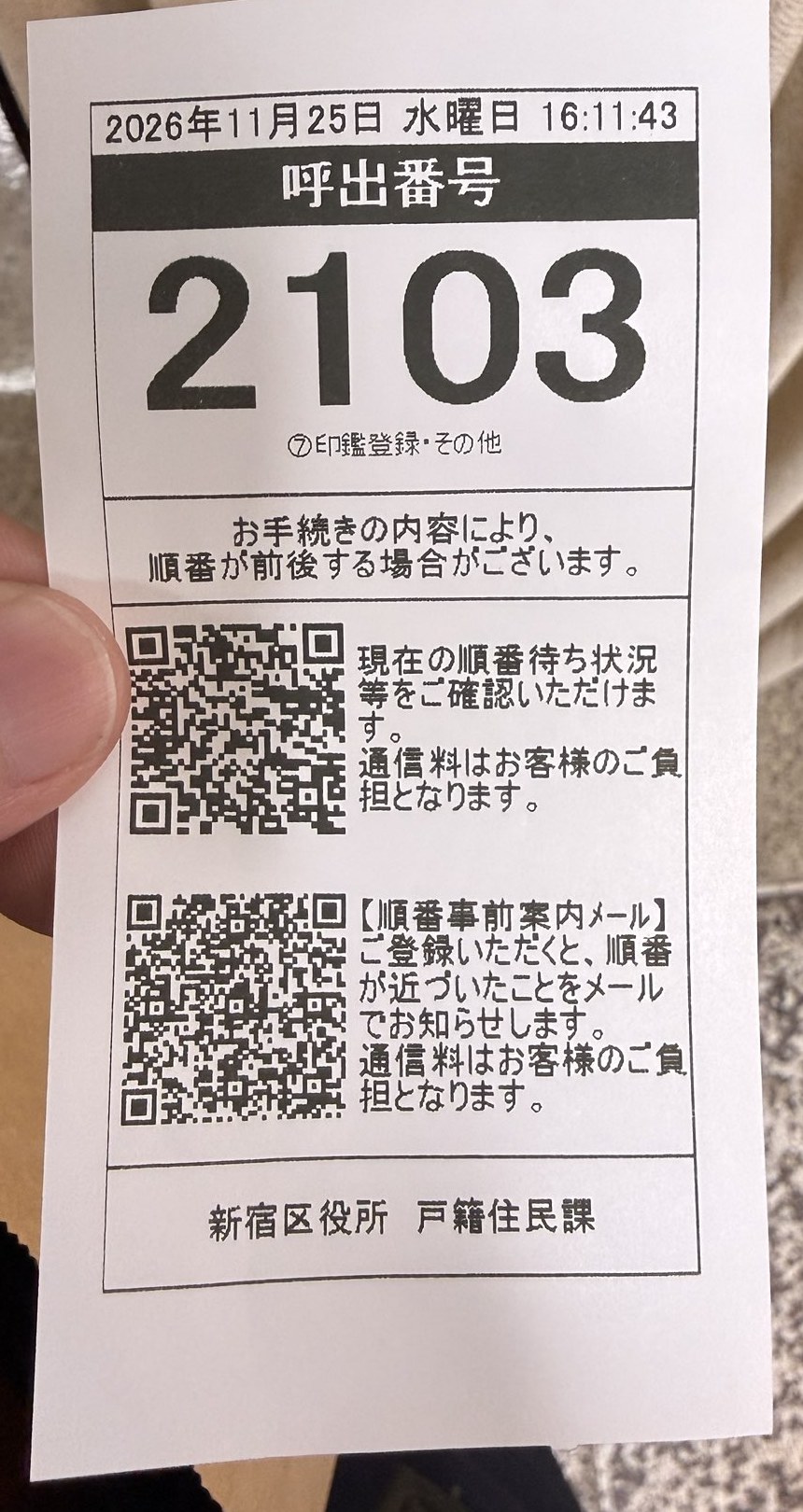
My ticket at the second visit. The number is good for one queue.
If the office kept a trace of my second visit, it would look like this. I drew it from memory.
My second visit, one bar per step. Of the 75 minutes, 50 to 60 were waiting.
I was the context object#
I had to explain my situation, what happened at my last visit, and why I came back, 3 times: to the floor guide, to her colleague, and to the woman at the desk. Then I wrote the same details on 3 forms. In a backend, a context object carries all of that from service to service. At the office, I was the context object.
In software, a request carries an ID and the service looks up the rest. At the desk, my ID card was sitting in front of the staff, and almost everything the forms asked for is printed on it. The office had my ID and still asked me to write out what the ID says.
My filing got no confirmation#
At the first visit I handed in a form to change my name back. I asked to photograph it and was told no. A service that saves a change replies: saved, and here is your reference. I left with nothing in writing. No email was coming either: the office has never asked for mine.
Before I left, the staff said the change would take a week or more to reach every system, and told me to avoid using my ID until then. That is eventual consistency. A system built that way lets you check whether a change has arrived. I had no way to check. For weeks my card still said Gai, and at the doctor's I kept explaining that my name is Kai.
The reason was the card itself. The family register is the source of truth, and my card is a snapshot of it. The snapshot goes stale the moment the record changes, and it only updates when I bring the card back to a desk. Nobody told me that at the first visit.
The name change was a bad backfill#
In 2025 the government added a new field to every citizen's family register: the reading of their name. Filling in a new field for records that already exist is a backfill. To do it, each city mailed people the reading it planned to record, and if nobody answered, that reading became official.[2] My letter went to an address I left 12 years ago, so nobody answered. A guess was written into my official record as if I had confirmed it. The passport the same government issued me says KAI.
The office counts forms, not people#
Shinjuku ward office publishes how many requests it handles, by type.[3] A backend tracks much more than that.
| What a backend tracks | Does the office know? |
|---|---|
| Requests | Yes, by type |
| Unique visitors | No |
| Error rate | No |
| Resolution rate | No |
| Retries | No |
| Repeat visits for the same problem | No |
My case was 4 requests, one wrong desk, 3 explanations and one repeat visit. The office's numbers show the 4 requests and nothing else.
Part 3 is a thought experiment: how I would digitize an office like this without closing it.
References#
- 新宿区, 窓口受付・混雑状況, updated October 29, 2025.
- 法務省, フリガナが記載されるまで.
- 新宿区, 令和7年度事務事業概要(地域振興部), as of April 1, 2025, p. 25.