10 min read2,049 words
GMO breach, part 4: Japan's new privacy fines law does not cover breaches like GMO's
The first penalty Japan's privacy regulator can impose on its own was enacted in July 2026. It applies to 4 kinds of violation and charges a company only what it gained, so a breach caused by careless security goes unpunished.
On July 10, 2026, Japan's parliament passed the first penalty the privacy regulator can impose on its own: a surcharge, a sum it can order a company to pay without going to court. It applies to 4 kinds of violation and charges the company what it gained from them. A breach caused by negligent security is not among the 4.[1] Less than a month later, attackers got into Onamae.com Desktop Cloud, a service run by GMO Internet Group, a Japanese internet company, that rents out virtual Windows computers. From August 17 they held an administrator account on the GMO computer that controlled thousands of customers' rented machines, and from late September they used it to install malicious software on them.[11] The only price anyone at the company has paid so far is a 3-month pay cut: 30% for the chief executive and 20% to 25% for 3 other executives.[2] On November 6 the government answered the wave of breaches with an emergency package backed by about ¥10 billion, and the package contains no penalty for a company that leaks data.[17][18]
What the new law does#
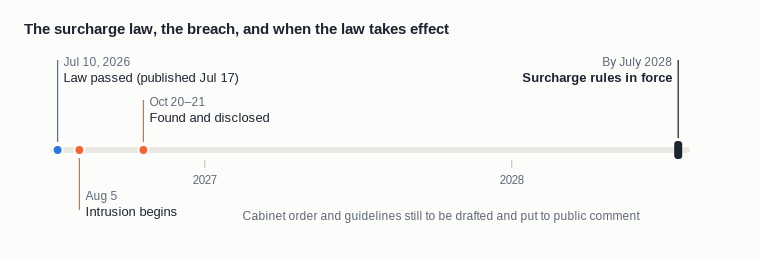
The amendment to the Act on the Protection of Personal Information was enacted on July 10, 2026, published on July 17, and takes effect on a date the cabinet will set within 2 years of publication, so by July 2028 at the latest. Only its criminal-penalty provisions start earlier, 6 months after publication.[1] The surcharge provisions, as summarised by the Personal Information Protection Commission (the privacy regulator), work like this:[3]
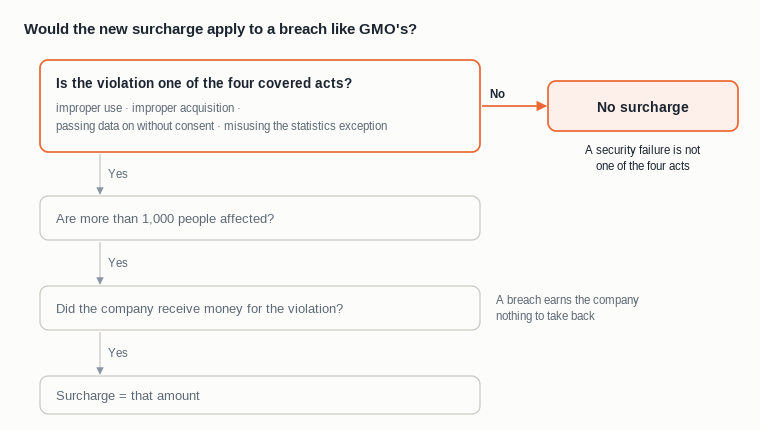
- The Commission can order a surcharge for 4 kinds of conduct: improper use of personal information, improper acquisition (for example, by deception), passing data to other companies without the required consent, and misusing the exemption that lets companies combine customers' data for statistical research without asking permission.
- The order is available only when the data of more than 1,000 people is involved.
- The amount equals what the company was paid for the violation or for stopping it, for example the price it was paid for the data. A repeat within 10 years multiplies it by 1.5; self-reporting halves it.
None of the 4 covers failing to secure data. Even if one did, the surcharge equals what the company earned from the violation, and a company earns nothing from being breached, so there would be nothing to charge.
Breach penalties in Australia, the EU and the US#
Australia had its 2 largest data breaches of 2022 at the telecom Optus, disclosed on September 22,[4] and the health insurer Medibank a few weeks later.[5] On October 26, 34 days after the Optus disclosure, the attorney-general introduced a bill raising the maximum penalty a court can impose for a serious or repeated privacy breach to the greatest of 3 figures: A$50 million, 3 times what the company gained, or 30% of its Australian turnover during the period of the breach.[16] Parliament passed it on November 28, and the new maximum took effect on December 13, 2022, 82 days after the Optus disclosure.[6] It does not reach Medibank, whose conduct ended in October 2022. Australia's privacy regulator is suing Medibank in the Federal Court over 9.7 million people's data under the old cap of A$2.22 million per breach.[5]
The European Union's privacy law, the GDPR, sets administrative fines of up to €20 million or 4% of worldwide annual turnover, whichever is higher, for breaches of its core principles in Article 5, including the duty to process data securely (Article 5(1)(f)) and to collect only what is necessary (Article 5(1)(c)).[7] The United States has no general federal privacy fine; regulators act case by case, and after the 2017 breach at the credit bureau Equifax, the company agreed to pay at least US$575 million, including a fund of up to US$425 million for affected consumers.[23] The one federal rule that applies to every listed company concerns disclosure. Under a rule the Securities and Exchange Commission, the stock-market regulator, adopted in July 2023, a listed company must disclose any cyber incident it judges serious enough to matter to investors. The disclosure is a public filing on Form 8-K, due within 4 business days of that judgement.[8] GMO disclosed the day after it found the malware,[14] which would have satisfied the American rule. Japan's privacy law also sets a deadline, but for a report to the regulator, not to the public: a first report within 3 to 5 days of discovery.[15]
GMO's own measures#
The measures GMO has announced so far, from its own disclosures:
- Pay cuts of 30% for the chief executive and 20% to 25% for 3 other executives, for 3 months from December, with further measures to depend on an internal review.[2]
- A reward of up to US$1 million in total, funded by GMO itself, for information leading to the attackers. The figure matches the attackers' last demand.[9]
- A request to the government, on October 24, to invoke Japan's "active cyber defence" law. The law passed in May 2025, and its provisions letting the state access and neutralise attacking servers came into force on October 1.[20] The government replied that the law is not invoked at a company's request.[10]
The regulator cannot fine GMO for leaving unaddressed, for 2.5 years, the weaknesses its own security company reported in April 2024. The privacy law requires companies to protect personal data, but all the regulator can do is order a company to improve. Only ignoring that order is punishable, and the July law does not change this.[12]
The government's ¥10 billion response adds no penalty#
On November 6, 2026, the ministerial meeting on cybersecurity adopted an emergency package, and the cabinet approved about ¥10 billion for it from the budget's reserve fund.[17] Of that, about ¥2 billion pays for AI checks of government systems for weaknesses, about ¥4.1 billion for police equipment and training for cyber investigations, and about ¥3.8 billion for the security of the Digital Agency's systems. None of it is paid to a private company.[19][20] The Japan Times reported that the government convened the ministerial meeting after GMO publicly asked it to intervene.[20]
An outreach team at the National Cyber Office will contact organisations it judges to be at risk and help them find intrusions they have not noticed. A public-private rescue corps will be sent to a breached organisation that asks for help, when the office judges the need especially urgent; its secretariat is to be set up within this fiscal year. A team to be set up in November at the Information-technology Promotion Agency will run penetration tests (authorised mock attacks that look for weaknesses) itself and train the security firms that serve private companies to run them. Small businesses get recovery and backup added to an existing support service, the Cybersecurity Otasuketai service.[18] The privacy regulator will revise the examples of methods in its security guidelines, aiming to have the revision in force in January 2027, and has asked companies to delete personal data they no longer need. For reported leaks, it will investigate and, where it finds problems, use supervisory powers such as guidance and advice.[18] Most of these measures have the state do the work for companies, before or after an attack.
The package's own diagnosis is that many recent leaks came from known weaknesses left unfixed, misconfigured websites and missing basic measures at the company or its contractors.[18] GMO fits that description, and it already had a penetration test: its own security company, Ierae, ran one in April 2024 and reported the weaknesses, and the finding went no further than 3 executives.[11] Nothing in the package would have required GMO to act on that finding or made ignoring it cost anything.
When the breach came, GMO spent its press conference talking about the attackers, not the warning. Part 2 explains why the warning carried no weight inside GMO.
What Japan's privacy law should add#
- Penalties tied to revenue, including for negligent security, paid to victims and to the regulator's investigations. Add inadequate security measures to the list of conduct that can draw a surcharge, and set the amount as a share of revenue rather than of gains, because a breach has no gains. The law as passed sends every surcharge to the national treasury.[3] Send it instead to a fund that compensates the people whose data was leaked and pays for the regulator's investigations. The United States does this with consumer-finance penalties, which go first to victims and otherwise to consumer education.[21] The United Kingdom does it in part, letting its privacy regulator keep up to £7.5 million of fines a year for litigation costs.[22] When the government's new rescue corps[18] helps a company whose breach is later found to be negligent, bill the company for it, while police work and government systems stay taxpayer-funded.
- A duty to report upward. Require that security findings from internal or commissioned audits be reported to the board within a fixed period, with the board's response recorded in the minutes. GMO's legal head said no standard for this existed;[13] make one mandatory.
- Detection requirements. Require companies to watch who signs in with full control over systems that hold customer data, and to check those records regularly. Under such a rule, 64 days of an intruder holding full control of the server that managed every GMO customer's machine[11] would itself be a violation.
- A duty to collect only what is needed. Add to Japan's privacy law the GDPR's rule that a company may collect only the data its stated purpose requires (data minimisation), and let the regulator enforce it.
- An earlier start date. The cabinet may bring the surcharge provisions into force on any date within 2 years of July 17, 2026.[1] Set that date in 2027, and amend the covered conduct before it arrives, so that the first surcharge order can reach a breach like GMO's. Australia went from the Optus disclosure to a higher maximum in force in 82 days.[6]
References#
- のぞみ総合法律事務所, 2026年(令和8年)改正個人情報保護法の概要(第1回). Enactment on July 10, 2026, promulgation on July 17, 2026 as Law No. 56, and the commencement schedule.
- セキュリティ対策Lab (Rocket Boys), GMO、サイバー攻撃で熊谷正寿氏ら役員4人が報酬減額, November 2, 2026.
- 個人情報保護委員会, 個人情報保護法等の一部を改正する法律について(政令・規則委任事項), October 14, 2026. Articles 148-3 to 148-7 and the surcharge summary.
- Office of the Australian Information Commissioner, OAIC statement on Optus data breach, September 22, 2022.
- Office of the Australian Information Commissioner, Medibank civil penalty action overview.
- Corrs Chambers Westgarth, Higher penalties and other Privacy Act amendments commence, December 2022.
- Article 83 GDPR, General conditions for imposing administrative fines, paragraph 5.
- U.S. Securities and Exchange Commission, SEC Adopts Rules on Cybersecurity Risk Management, Strategy, Governance, and Incident Disclosure by Public Companies, July 26, 2023.
- ビジネス+IT, GMO攻撃、「有力情報」を警察へ提出…懸賞金に270件、総務省は強制遮断を要請と報道, October 29, 2026.
- 熊本日日新聞(共同通信), GMO、サイバー防御を緊急要請 不正アクセス確認、適用なら初, October 24, 2026; Impress Watch, GMO、政府に能動的サイバー防御の適用を要請, October 2026.
- @IT, 「ネットのセキュリティもGMO」の実態 イエラエの事前指摘はなぜ放置されたか:GMO記者会見を読む, November 3, 2026.
- Japanese Law Translation, Act on the Protection of Personal Information (Act No. 57 of 2003), Article 23 (security control measures) and Chapter VI on the Commission's recommendations and orders.
- ITmedia Business Online via Yahoo! News, 「31年間『もうける』と言ったことはない」GMO熊谷代表、不正アクセスで謝罪も露呈した“組織の壁”, November 2, 2026.
- GMO Internet Group, 【重要】「お名前.com デスクトップクラウド」への不正アクセスに関する現在の対応について(第9報), October 27, 2026, with the first report dated October 21, 2026.
- Personal Information Protection Commission, 漏えい等の対応とお役立ち資料 (deadlines for breach reports to the Commission).
- Mark Dreyfus KC MP, Attorney-General, Second reading speech, Privacy Legislation Amendment (Enforcement and Other Measures) Bill 2022, October 26, 2022.
- 首相官邸, サイバーセキュリティに関する関係閣僚会議(第2回), November 6, 2026.
- 内閣官房 国家サイバー統括室, サイバーセキュリティ緊急対策パッケージ, 資料2, November 6, 2026.
- 時事通信 via Yahoo! News, サイバー対策強化に100億円 政府が予備費支出決定, November 6, 2026.
- The Japan Times, Takaichi administration announces emergency cyberdefense package, November 6, 2026.
- 12 U.S.C. § 5497(d), Consumer Financial Civil Penalty Fund, via Cornell Legal Information Institute.
- Mishcon de Reya, ICO to keep money from UK GDPR fines, June 15, 2022.
- Federal Trade Commission, Equifax to Pay $575 Million as Part of Settlement with FTC, CFPB, and States Related to 2017 Data Breach, July 22, 2019.